Claim: "UK can’t afford Net Zero"
Quick Reply
The evidence is clear: transitioning from fossil fuels to homegrown renewable energy will make the UK more prosperous, more secure and less exposed to global shocks.
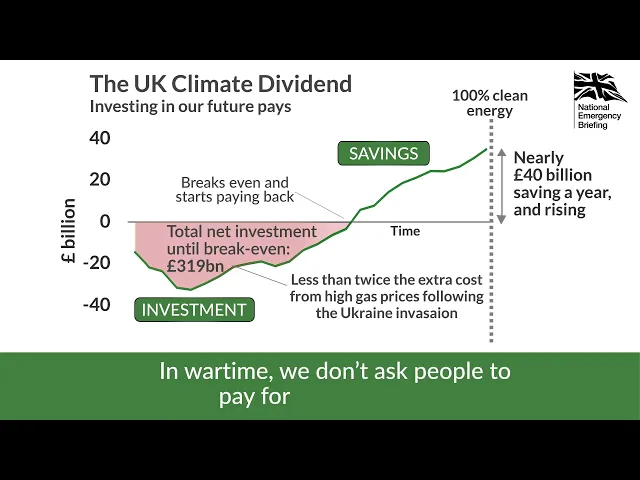
The Climate Change Committee reports that the net investment required is just 0.2% of GDP, or an average of £4 billion a year. This will generate net savings of nearly £40 billion every year through greater efficiency and cheaper energy generation.
The CBI has identified the green economy as one of the fastest growing sectors of the economy: between 2023 and 2024 the sector grew by 10%, with every pound generated by the net zero economy creating an additional £1.89 in the wide economy.
Investing now will also help position the UK to compete in the industries of the future. Countries that move early will build the technologies, supply chains and skilled jobs of the future. Countries that delay risk becoming dependent on importing them from others. The choice is whether the UK becomes a supplier in the economy of tomorrow, or simply a customer buying in technologies developed elsewhere.
Continuing on our current path, on the other hand, risks severe economic damage. The Institute and Faculty of Actuaries warns that the global economy could face a 50% loss in GDP between 2070 and 2090 unless immediate policy action on risks posed by the climate crisis is taken.
More Detail
The Climate Change Committee has modelled the transition away from fossil fuels across the entire UK economy and reports that the net investment required to 2050 is just 0.2% of GDP, or an average of £4 billion per year. This is 73% cheaper than was estimated only 5 years ago.
Transitioning away from fossil fuels will deliver savings to the nation of almost £40 billion every year, and rising - partly because electric technologies like EVs and heat pumps use use energy far more efficiently, and partly because renewables like wind and solar are generally cheaper to produce than fossil fuels.
Globally, a leading study has found that decarbonising the energy system by 2050 will save $12 trillion, and the faster we go, the more we will save.
The Climate Change Committee reported recently that the cost to the UK of a single oil shock - like the one after Russia invaded Ukraine in winter 2022/3 - is roughly the same as the entire cost of transitioning the UK fully to renewables.
It is true that funds will be needed up-front for the investment required, but the roughly £320 billion required is less than the £300 - £400 billion that the UK spent on the pandemic. And unlike the pandemic, upgrading from fossil fuels will generate a strong financial return.
This animation uses numbers produced by the Climate Change Committee, as reported in their Seventh Carbon Budget.