"The government is already delivering climate leadership"
Quick Reply
The UK has made real progress, particularly in clean power. However, across the whole economy, emissions are not falling at the pace that many experts say is required to manage current risks. In some areas, emissions are broadly flat, and in others they have increased.
Once imports, aviation and shipping are included, the UK’s emissions have fallen by around 20% since 1990 - or about 0.6% per year.
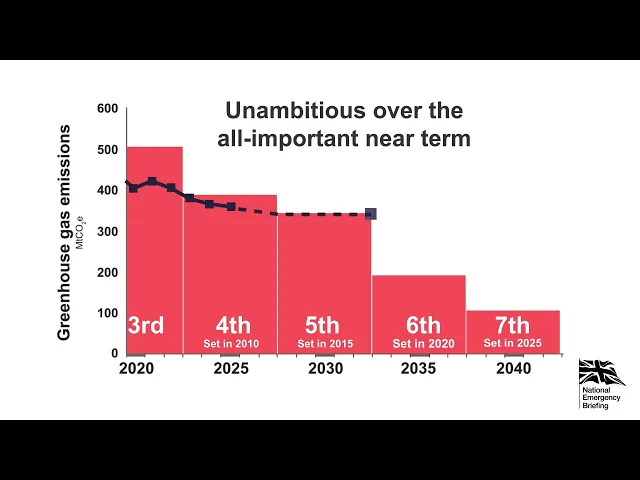
It is true that the UK’s longer-term targets are more ambitious, strengthened in line with recent science. However, near-term targets covering the period to the early 2030s were set over a decade ago, based on the scientific understanding available at the time, and only require emissions cuts of around 1% per year.
This inconsistency means that near-term targets do not pave the way for the UK to meet its longer term goals.
NEB expert Professor Kevin Anderson has explained that even to limit warming to 2°C, the UK’s fair share of emissions cuts would mean a reduction of around 13% per year. That would require transformative action across the whole economy in the near term.
The UK is doing more than before. But the key question is whether current progress is sufficient given the level of risk described by climate science.
More Detail
1. Assessing Performance
The UK should be credited for significant progress in reducing ‘territorial’ emissions, which have fallen by around half since 1990. But we should also acknowledge that this partly reflects the offshoring of manufacturing. Those emissions are still happening - and embedded in the goods we import.
Territorial emissions are only one portion of the UK’s climate impact. Once imports, aviation and shipping are included, the UK’s total carbon footprint has fallen by only around 20% since 1990, or roughly 0.6% per year.
This is far short of the reduction that many scientific analyses show is required. As Professor Kevin Anderson made clear in his expert briefing, even for limiting warming to 2°C, high income countries like the UK would need to cut emissions by around 13% per year - a pace far faster than historical rates of reduction outside of wartime.
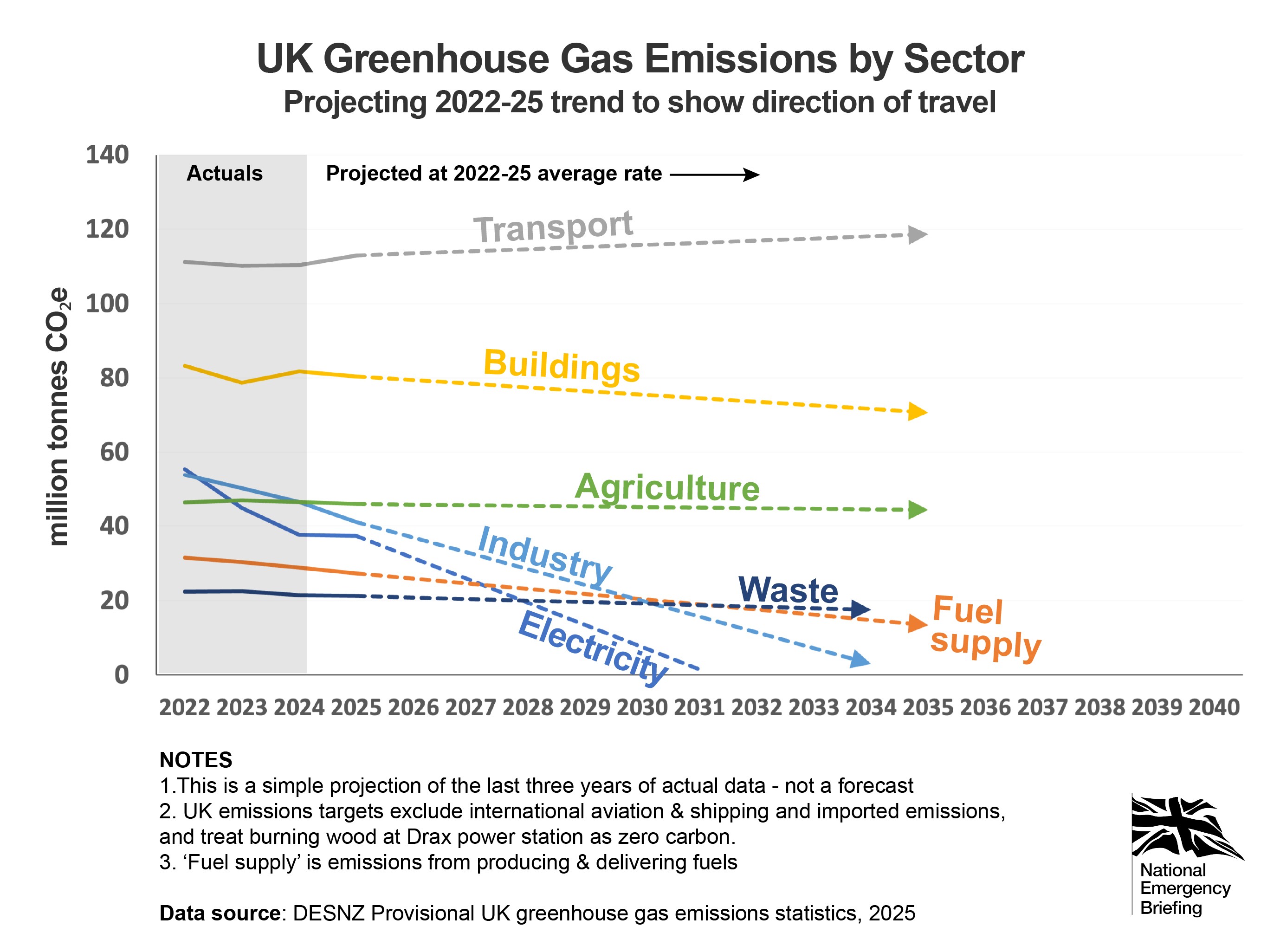
The following chart shows UK emissions by sector. It takes the actual performance from the last three years, to 2025, and projects it forwards. This simple approach helps show how UK is doing, and demonstrates clearly that we are far off track.
The UK has made rapid progress in decarbonising electricity, supported by policies such as Clean Power by 2030. However, electricity represents only around a fifth of total energy use. Across other sectors - particularly transport and housing - emissions have reduced more slowly, and in some cases have remained broadly unchanged.
2. Adequacy of targets
The UK’s near-term targets - covering the vital years to the end of 2032 - were devised over a decade ago. Since then, scientific understanding of climate risks has advanced significantly, including:
The UN’s 2019 landmark SR1.5 report clarifying the dangers of exceeding 1.5°C
Growing evidence that some climate impacts are hitting us up to 25 years earlier than expected.
growing understanding of tipping point risks, including the potential collapse of systems such as the AMOC ocean circulation. Professor Tim Lenton warns that AMOC collapse would have severe implications for agriculture in the UK
These targets also did not fully anticipate the extent to which emissions associated with UK consumption would be shifted overseas.
As a result, these targets only require cuts of an average of 1% a year to the end of 2032. UK is already comfortably on track to meet these near-term targets without whole-of economy action. Reducing emissions in line with the 5th Carbon Budget will the UK facing an unrealistically steep and difficult reduction then required to meet the 6th Carbon Budget.
3. Implications
If the underlying assumptions behind current targets and pathways have changed, it may be appropriate to reassess whether they remain aligned with current scientific understanding of risk.
Delays in economy-wide emissions reductions have several implications, including:
the narrower the window for orderly transition
the greater the risk that climate impacts themselves begin to disrupt and derail decarbonisation efforts
NEB expert Lt General Richard Nugee warned that:
“Government systems and institutions risk being overwhelmed, not just strained. The biggest concern is that we're facing the potential of an ungovernable state unless government takes this seriously”.
NEB adviser Laurie Laybourn describes this as ‘derailment risk’.
4. Public understanding and response
Progress in sectors such as housing and transport is likely to depend in part on public understanding and support - both for changes in behaviour and for the level of public investment required.
This buy-in will remain difficult to secure whilst people don’t understand the threat or that positive solutions exist. A televised emergency briefing - aimed at improving understanding of the risks and the available response options, and establishing a shared baseline for action - will put the government on the front foot, and could unlock the genuine emergency action needed to protect the country.