Claim: "The UK has made great progress, with emissions down by around 50% since 1990"
Response
The UK has taken some major steps to protect our shared environment. Under the Conservative government, the UK was the first nation in the world to adopt a net zero target, and the UK is making excellent progress in building cheap homegrown renewables capacity.
However, across the whole economy, emissions are not falling at anywhere near the pace that many experts say is required, based on the latest understanding of risks faced.
NEB expert Professor Kevin Anderson explained that even to limit warming to 2°C, the UK’s fair share of emissions cuts would mean a reduction of around 13% per year from now. But UK emissions fell by only 1.8% in 2025.
The graphic below looks at how actual emissions by sector have changed over the three years to 2025, and then projects forward at the same rate. This simple exercise helps highlight where policy is working, and where more is needed.
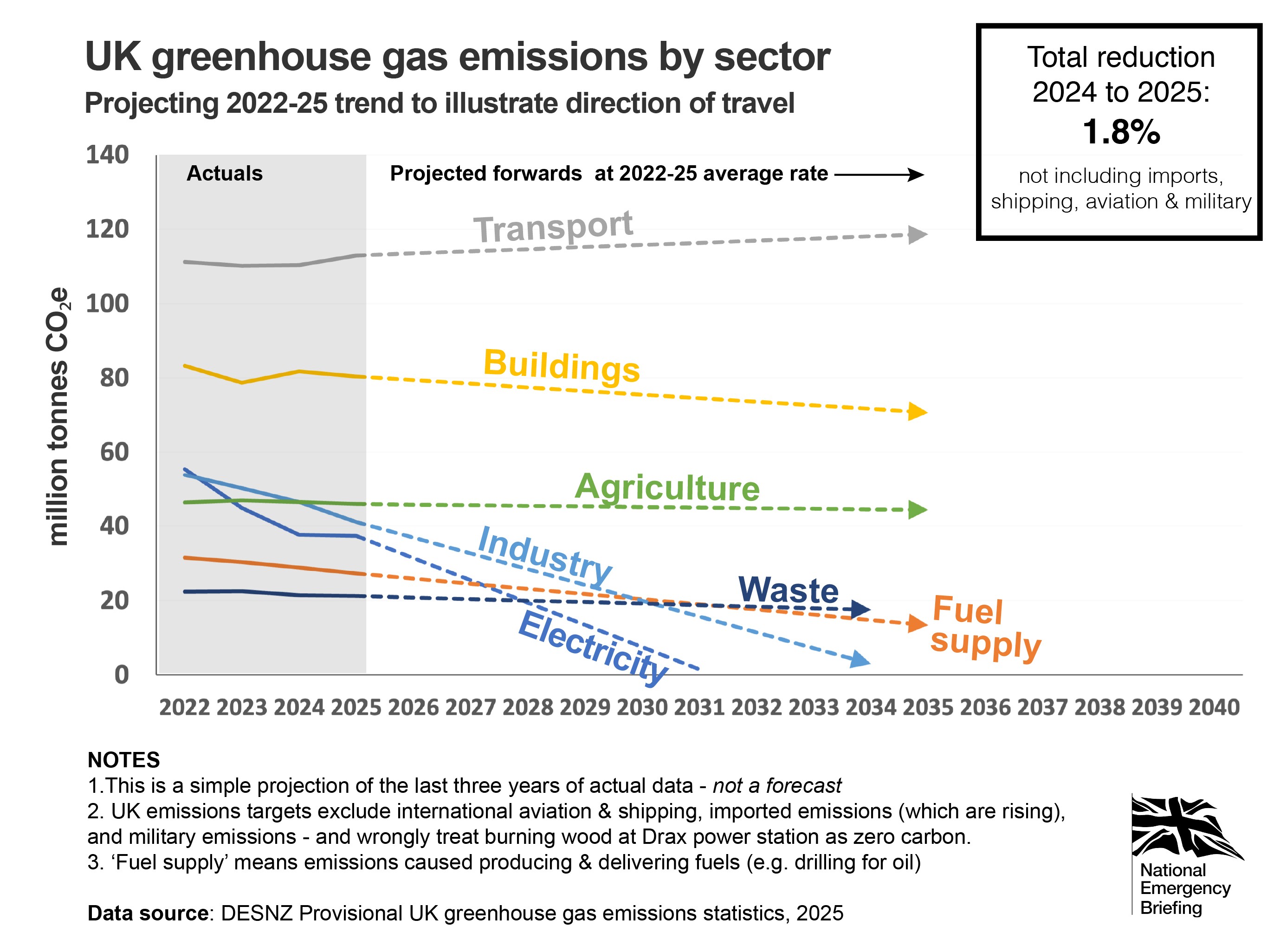
Fantastic progress has been made in reducing emissions from power generation, but in most other major sectors, emissions are effectively flatlining.
That's because decarbonising electricity can happen largely behind the scenes, but doing the same for transport, housing and agriculture needs public understanding and support.
The survey data collected at our film screenings is telling us that people largely have little idea of the scale and immediacy of the threats to British life - or that the solutions already exist. People cannot be expected to support and make major changes if no-one has explained why. We plan to report interim survey results within the next month.
More Detail
The UK should be credited for significant progress in reducing ‘territorial’ emissions, which have fallen by around half since 1990. But we should also acknowledge that this partly reflects the offshoring of manufacturing. Offshored emissions are still happening - and embedded in the goods we import. UK figures also still ignore international aviation and shipping, and military emissions.
Territorial emissions are only one portion of the UK’s climate impact - and once net imports, aviation and shipping are included, the UK’s total carbon footprint has fallen by only around 20% since 1990, or roughly 0.6% per year.
This is very far short of the reduction that many scientific analyses show is required. As Professor Kevin Anderson made clear in his expert briefing, even for limiting warming to 2°C, high income countries like the UK would need to cut emissions by around 13% per year from now - a pace far faster than historical rates of reduction outside of wartime.
The UK has made rapid progress in decarbonising electricity, supported by policies such as Clean Power by 2030. However, electricity represents less than a fifth of total energy use. Across most other major sectors, minimal progress has been made over recent years. The graphic below illustrates this, by projecting forwards the last three years' actual emissions.
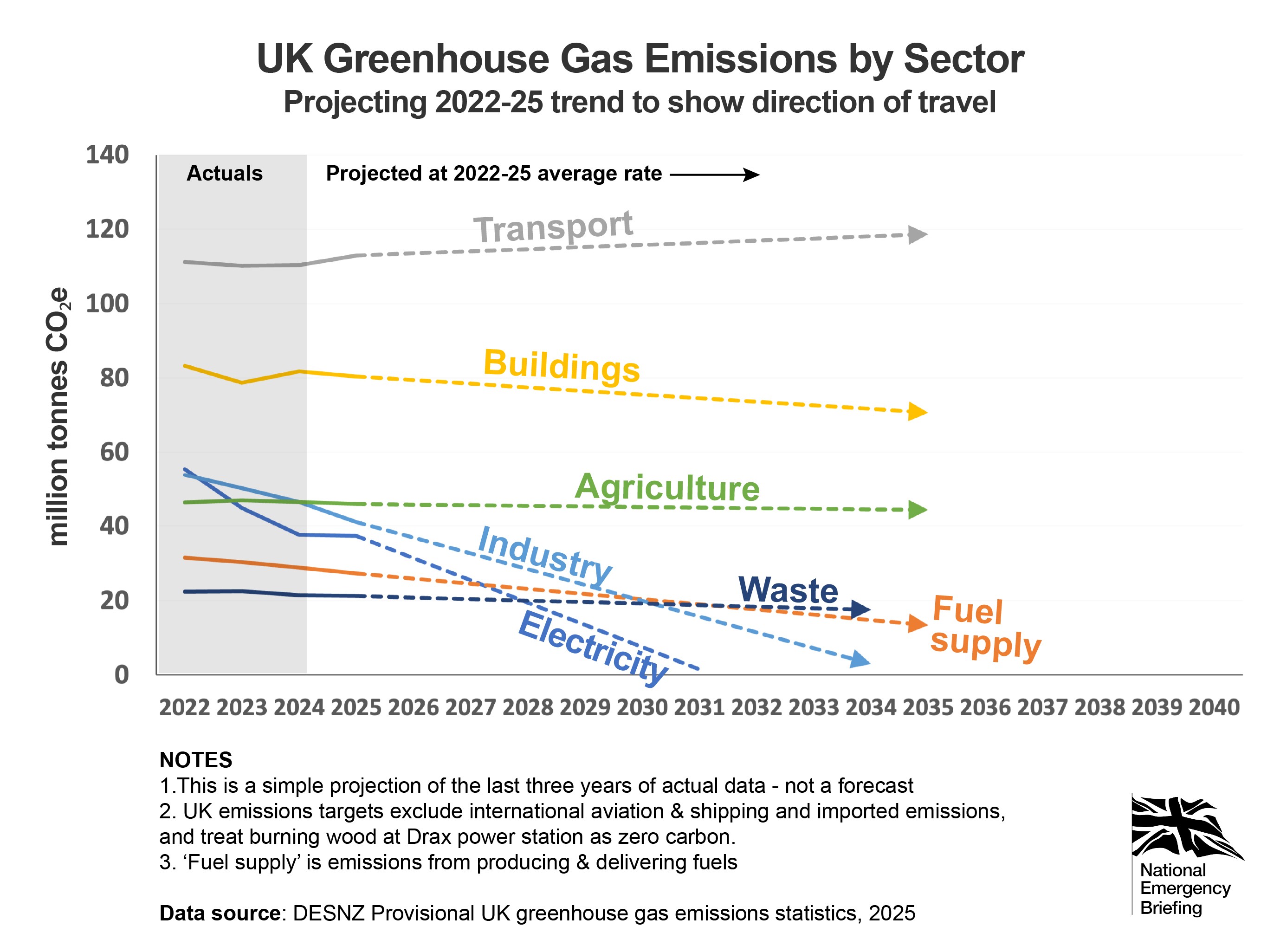
Unlike in the power sector, where decarbonisation can happen largely out of sight, making progress in transport, buildings and agriculture will involve changes in people's lives. It cannot be achieved behind the scenes and will require a whole-of-society effort. That means levelling with people, explaining why this effort is needed.
